Frequently asked questions
Vasectomy in questions and answers
After a vasectomy, am I 100% certain that I am infertile?
Vasectomy is without doubt one of the most effective methods of preventing pregnancy and the most reliable method of contraception that remains under a man’s control. It is also considered one of the safer surgical procedures, with the fewest complications.
The error rate for the so-called “Canadian method” is 0.5%. This means that, statistically, 5 in 1,000 men after a vasectomy may remain fertile and the procedure has to be repeated.
For other no-scalpel vasectomy methods, scientific publications show that between 5% and 13% of procedures have to be repeated because of so-called “early recanalisation”, i.e. a situation in which 5 to 13 men in 100 must undergo the procedure again.

Which vasectomy method is best?
The American Urological Association carried out an analysis of all available scientific publications published in respected medical journals between 1949 and 2011. About 70 researchers analysed the results of several thousand papers.
It turned out that the discrepancies in reports on the effectiveness and complications of vasectomy result mainly from the method used to perform the procedure. The oldest techniques, consisting in cutting and tying both ends of the vas deferens, carry the highest failure rate. In some centres the need to correct the procedure, because of the constant presence of sperm in the ejaculate, reached as much as 13%.
It should be stressed, however, that even in those cases the pregnancy rate still remains very low.
The American Urological Association recommends using the open-ended method (Open Ended), with the testicular end of the vas deferens brought outside the sheath of the spermatic cord (FI – fascial interposition), as well as cauterisation of the segment leading to the penis (thermal cautery).
Original text in English
The most common cause of the return or persistence of fertility after a vasectomy is that “searching” sperm find alternative routes, an error in identifying the vas deferens, or the presence of a double vas deferens on one side.
If the first semen analysis shows no sperm, the risk of fertility returning in the future is extremely low – about 1 in 2,000 cases.
Is the vasectomy procedure itself painful?
Every person is different and reacts differently to painful stimuli. In some patients the very fear of the scalpel may cause resistance to the vasectomy. That is why in our practice we try to eliminate stress-inducing elements, such as the use of a scalpel, so that the whole procedure takes place in the most pleasant atmosphere possible.
Of course we cannot guarantee a completely painless vasectomy, although in most cases that is exactly what it is. The patient feels only the doctor’s manipulations in the intimate area. Sometimes slight tenderness of the operated area may appear.
How will a vasectomy affect my sex life?
We hope positively 🙂. A vasectomy does not affect libido, erection or the ejaculate. It only blocks sperm, preventing them from getting into the semen. The level of male sex hormones does not change either.
If, however, the man or his partner have a negative emotional attitude towards the procedure, this may affect the satisfaction from intercourse on one side. That is why it is worth thinking the decision about a vasectomy through together.
In most cases, however, a feeling of relief appears – you can enjoy greater freedom, and both partners feel greater pleasure from intercourse.
After a vasectomy, will I have a normal ejaculation?
Yes, of course. The volume of the ejaculate after a vasectomy decreases by only 2 to 5%, which is imperceptible to the naked eye.
The appearance, smell, consistency and viscosity of the semen remain unchanged. Without a microscopic examination it is impossible to tell whether sperm are present in the ejaculate.
What happens to the sperm after a vasectomy?
The body continues to produce sperm just as before the vasectomy. Thanks to leaving the testicular end of the vas deferens open, the sperm leave the testicles outside the sheath of the spermatic cord into the scrotum.
In the scrotum a small amount of fluid is naturally secreted, and the same amount is absorbed. This serves to allow the testicles to move freely.
The absorption system copes with eliminating sperm without any problem – they are removed by the cells of the immune system, just like old, worn-out or abnormal cells in other parts of the body.
Why is a vasectomy not effective immediately (do I still have to use protection)?
Indeed, you have to wait a while for the final effect. This is because, after being produced in the testicles, sperm travel to several “stores” in the area of the bladder, including the prostate, the ampullae of the vas deferens and the seminal vesicles, where they are kept together with the other components of the ejaculate until ejaculation.
The body needs many ejaculations to get rid of the remaining reserves of sperm – some patients may clear them completely only after 40-50 ejaculations. In some, sperm may be present for up to 6 months.
What is the risk of complications after a vasectomy?
As with all surgical procedures, with a vasectomy too you have to reckon with the risk of complications. Of course that risk is small – about 99% of any complications can be managed with rest or over-the-counter anti-inflammatory medicines.
In a few cases a medical consultation may be necessary, and in extreme cases an additional procedure.
Which vasectomy method is used at ZdrOva?
There are many variants of vasectomy methods. Since tens of millions of such procedures have already been performed worldwide, their effectiveness and the risk of complications have been analysed in detail.
Currently the most effective and safest method is considered to be the so-called electrocautery, open ended, fascial interposition – No Scalpel Vasectomy.
It consists in cutting the vas deferens and bringing its open (unblocked) testicular end outside the sheath of the spermatic cord, while blocking the patency of the prostatic end (the one leading to the penis) and leaving it inside that sheath.
The opening in the sheath is closed with sutures or titanium clips. As a result, neither end of the vas deferens is tied or clamped. The end towards the penis is thermally shrunk over a length of about 10-15 mm, while the end on the testicle side freely releases the sperm produced throughout the rest of the patient’s life.
Why does the questionnaire include questions about private life?
The online questionnaire and the questions it contains are a modern form of medical interview – an example of so-called telemedicine.
Some patients find the questions irritating, unnecessary, nosy or incomprehensible. Nevertheless, each of them has a specific justification – the answers help to establish the indications and rule out contraindications for performing the vasectomy.
Every medical action carries a smaller or greater risk of complications. That is why every procedure, especially a surgical one – regardless of whether it is therapeutic or preventive – must be justified.
A principle universally accepted in medicine for thousands of years is that the benefits of treatment should outweigh the risk (primum non nocere – “first, do no harm”).
This means that before starting any course of action the doctor has a legal obligation not only to assess the indications for the procedure, but also to rule out contraindications.
The answers given in the questionnaire guide the further course of action – including the consultation, which currently takes the form of a phone call before the procedure.
Only on the basis of the questionnaire and that conversation can the doctor assess whether there are indications and whether there are no contraindications for carrying out a vasectomy, a procedure with serious consequences.
How many openings have to be made, and where, to perform a vasectomy?
Most often only one small opening is made in the scrotum, parting the skin without using a scalpel (is that possible? YES).
What is the advantage of the “Canadian”, or “keyhole”, vasectomy method?
This is the vasectomy method described in Quebec, Canada (top left corner in the figure alongside).
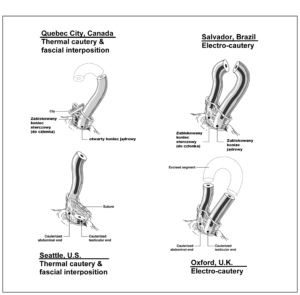
The advantage of this method is that the failure rate (the need for a repeat procedure) falls within the range of 0-0.5%. With no-scalpel vasectomy in the variants where both ends of the vas deferens are closed with sutures or clips (tying, clamping), the failure rate may reach as much as 13.5% (see: table 5, American Urological Association Guideline on Vasectomy). The internet is full of posts by frustrated patients describing that they still have sperm after their vasectomy.
In line with the recommendations of the American Urological Association, many experienced practitioners – even those who have performed many thousands of procedures using older methods – are learning this variant from scratch and switching to it.
What is difficult about this new vasectomy method?
The difficulty is that the spermatic cord has a very complex venous plexus which must not be damaged. That is why the operator’s experience (i.e. the number of procedures performed using this method) is so important.
During charity missions within No Scalpel Vasectomy International we train doctors even from the United Kingdom, where vasectomy is very popular. Since nowhere in Europe is there a centre teaching this variant, Dr Kulik went specially to the USA to learn it. Over the last 9 years he has performed over 5,000 procedures and has also trained several doctors.
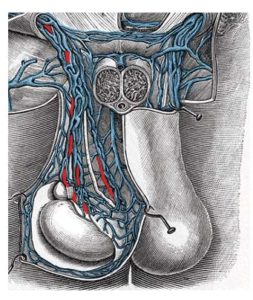
There are a great many blood vessels in the scrotum. This makes it more difficult to bring the open end of the vas deferens outside the spermatic cord. An open end outside the spermatic cord reduces the risk of pain complications.
Will I feel pain after the vasectomy?
70% of patients after a vasectomy feel nothing at all or only slight discomfort. 30% of patients feel some discomfort in one testicle, in both testicles, sometimes in the groin or above the pubic symphysis. Such discomfort may last from 7 to 28 days. The vast majority of patients in this group do not need to take any painkillers. They often say that “it is not enough pain for me to take any medication”.
On the day of the procedure about 10% of patients take ibuprofen. The next day – only 2-3%. Fewer than 1% of patients take painkillers for several days. Which group a given patient will fall into is unpredictable. However, discomfort or pain after a vasectomy happens more often in physically active people (heavy work, sport), and how it is felt depends largely on individual tolerance of discomfort and on the pain threshold.
To sum up: over 90% of patients, after about 7-14 days, feel no complaints at all related to the vasectomy they have undergone.
Can I drive after a vasectomy?
Most often yes. After the vasectomy, before the journey back, you should wait about 30 minutes. That time can be used, for example, for a meal. People prone to fainting – e.g. when blood is taken or at the sight of blood – should arrange transport home (e.g. come with a driver, return by taxi) or wait about an hour.
Can everything be “done” during a single visit?
Yes.
Can I come for the vasectomy with my wife?
Usually yes! The presence of a close person is beneficial and a companion is welcome.
However, during the period when sanitary restrictions (so-called social distancing) are in force – unfortunately the companion cannot even stay in the waiting room. They may only use the toilet.
What is the price of the vasectomy and can I pay by card?
2,000 zl
The procedure can be paid for both in cash and by payment card.
How long does a vasectomy take?
Everything takes place during a single visit, which lasts about 40-90 minutes.
The procedure itself usually takes 10-20 minutes.
Most of the time is taken up by formalities – that is why we ask you to arrive about 10 minutes before the agreed appointment time.
How should I prepare for the vasectomy?
• You should shave the genitals thoroughly (preferably the whole area, including above the penis). If you have never done this before, it is best to do it 4-5 days before the planned date.
• You should wear tight briefs (this is not essential, because the patient will receive from us a so-called suspensory, i.e. the protector used by wrestlers).
• You must not eat for 3 hours (after a light meal without meat, fish, vegetables or fruit) or for 6 hours before the procedure in the case of a heavier meal.
• You must have with you a physical (plastic or paper) photo ID document (identity card, driving licence, passport) – needed to set up the medical records.
• You must have had the telephone consultation, preceded by filling in the questionnaire (the medical interview). Without the telephone consultation the procedure cannot take place. Without the completed questionnaire the telephone consultation cannot be held.
Do I have to lie down straight after the procedure?
No, but activity should be limited. You can drive (taking into account the break after the procedure), but it is better to avoid walking for too long. If the journey home is long, it is a good idea to take provisions with you (sandwiches, a thermos) and eat in the car. If you plan to travel by train, it is worth buying a seat reservation so that you have a guaranteed seat.
Can I work normally after the procedure?
Immediately after the procedure, activity should be limited. The next day – if the work is light – it can be done, provided the perineum is protected against possible injury.
When after a vasectomy can I start sports training or very heavy physical work?
Heavy physical work (a pickaxe, an axe, a shovel, any lifting and throwing of heavy weights) is best postponed for at least 7 days. Dynamic training (football, tennis, martial arts, etc.) is best started after 2-3 weeks because of the risk of discomfort. Static exercises (e.g. the gym), where you can choose the muscle groups and the loads, can be taken up from the 8th day after the procedure (but really carefully, without “bearing down”, i.e. without grunting).
If these recommendations are not followed, discomfort or pain usually appears (normally resolving on its own). Rarely, a haematoma may form. The appearance of pain often makes the patient anxious that something has gone wrong. For example: during the charity vasectomy missions in the Philippines our patients (often very poor) most often return to physical work the very next day. They are advised not to lift weights exceeding 30 kg. Their complication rate (e.g. haematomas) is about 0.5%.
When after a vasectomy can I start having sex?
Before starting an intensive sex life it is worth waiting 7-10 days after the procedure. Gentle intercourse (e.g. in the “spoon” position) is possible as early as 2-3 days after the procedure.
When after a vasectomy can I stop using other contraceptive protection?
Additional contraceptive methods must be used until the semen analysis has been carried out and confirmation obtained that there are no longer any sperm in it.
Is 100,000 sperm per 1 cm³ really a successful vasectomy?
At first glance the figure of 100 thousand sperm may sound worrying. However, under normal conditions 1 cm³ of ejaculate contains on average 50-100 million sperm. Some record-holders have as many as 500 million. A man with fewer than 15 million sperm per 1 cm³ usually has significant problems fertilising his partner.
According to the guidelines of the American Urological Association, an effective vasectomy means fewer than 100,000 immotile sperm per 1 cm³ – that is, 150 times less than the minimum value regarded as normal.
These residual amounts of sperm after a vasectomy usually result from them remaining in the “stores” above the point where the vas deferens was cut – that is, in the accessory glands such as the prostate and the seminal vesicles.
What is a sperm granuloma?
A sperm granuloma (sperm granuloma) is a vascularised nodule appearing in the area of the vas deferens or the epididymis. It is spherical or irregular in shape and from a few to several millimetres in size. It consists of immune system cells (macrophages, connective tissue cells) and often contains a rich blood supply. It forms around sperm that have escaped outside the vas deferens – usually within the spermatic cord.
It is an autoimmune reaction of the body against sperm that have crossed the blood-testis barrier. This barrier protects sperm from the immune system, which sees them as genetically foreign and potentially dangerous. Every sperm cell has a unique set of genes differing from the host’s genetic code.
A sperm granuloma most often causes no symptoms at all. Sometimes, however, it may cause pain and lead to chronic testicular complaints.
Is vasectomy the most common cause of sperm granuloma and chronic pain?
No. The most common cause of a sperm granuloma is an injury to the scrotum (even many years earlier) or inflammation of the epididymis – e.g. as a complication of a genital infection (usually caused by harmless environmental microorganisms or by sexually transmitted diseases). The vasectomy procedure itself (especially in its older versions – without bringing the open end of the vas deferens outside the spermatic cord) comes only third among the causes of chronic testicular pain.
When can chronic testicular pain occur after a vasectomy?
Such pain appears mainly when the procedure was performed using a method that completely closes the cut testicular end of the vas deferens. In that situation the sperm, which are still produced, have no outlet, which leads to increased pressure in the epididymis and in the closed segments of the vas deferens.
The solution is the method that leaves the testicular end open and brings it outside the sheath of the spermatic cord – the so-called Canadian variant.
A sperm granuloma may also be difficult to diagnose. On ultrasound it sometimes resembles a testicular tumour, which can lead to an unnecessary amputation of the organ.
If vasectomy is not the most common cause of pain in the male genitals – then what is?
This is explained by Dr Wojciech Ejchman in his article on the causes of pain in men who have never had a vasectomy. A vasectomy does not protect against other diseases – just as wearing glasses does not prevent food poisoning.
Some Polish doctors are very critical of the open-ended method. Why?
I do not know. If the criticism concerns the method itself, then the proper addressee of that criticism is the American Urological Association.
Since 2012 the AUA (American Urological Association) has recommended to all doctors performing vasectomies the method:
open ended, fascial interposition, thermal cautery.
In plain language: this is the technique with the open end on the testicle side (brought outside the sheath), while the end on the prostate side is closed thermally.
This method is somewhat more demanding technically, because it includes several additional steps.
Dr Kulik is not the author of this method – he simply performs the procedures strictly according to the recommended scheme.